Featured

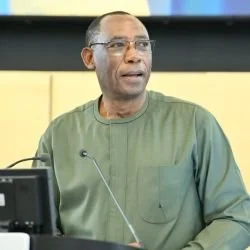



In order to promote the economic and social development of countries, you have to be clear about what economic and social development even means and how you'll measure these concepts. This is where official statistics excel. Many nations continue to build the capacity of their statistical systems to address the needs of their countries. Our episode today focuses on official statistics and statistical capacity development with guest Oliver Chinganya.
Statistical literacy was described by Ido Gall as "the ability to interpret, critically, evaluate and communicate about statistical information and messages". With that in mind, get ready to take a journey on all the ways our guests are promoting statistical literacy in this episode of Stats+Stories.
Nathan Yau is the author of several books on data visualization, including Visualize This and Data Fluency. He also runs the Flowing Data blog, where he works to make the process of creating data visualizations accessible to a wide audience. He recently published a defense against dishonest charts on his blog, which serves as a guide to determining which visualizations to trust.
The international prize in statistics is awarded every two years by a collaboration among five leading international statistics organizations: the American Statistical Association, the Institute of Mathematical Statistics, the International Biometric Society, the International Statistical Institute, and the Royal Statistical Society. The prize recognizes a major achievement by an individual or team in the statistics field, particularly an achievement of powerful and original ideas that have led to practical applications and breakthroughs in other disciplines. The International Prize in Statistics for 2025 was announced recently, and the winner is Grace Wahba. This episode of Stats+Stories is all about celebrating her career with her former students, Finbarr O'Sullivan and Douglas Nychka.
Early in the COVID pandemic, as we figured out how to live our lives solely at home, news stories began to be filled with stories about COVID’s spread and reproduction rates. Soon, social media were filled with amateur epidemiologists trying to make sense of those rates and sometimes making a mess of it. A series of articles in Significance examined the discourse around reproduction rates during COVID and it’s the focus of this episode of Stats and Stories with guest Gavin Freeguard.
Every year, statistics classes are filled with math averse students who white knuckle it to the end of the semester in the hopes of getting a passing grade. And the dream of forgetting about math and statistics for a little while. But what if it didn’t have to be that way? What if instead of white knuckling it, students were actually excited about the subject; or, at the very least, not terrified of it? Two professors has been developing strategies to help students get over their fear of “sadisistics” and that’s the focus of this special two part episode Stats and Stories
Being able to create compelling data visualizations is an expectation of a diverse array of fields, from sports to journalism to education. But learning how to create charts that spark joy can be difficult if you're not confident in your abilities. A recent book is designed to help people become more comfortable creating compelling charts, and it's the focus of this episode of Stats and Stories with guest Alli Torban.
The democratic engine of the United States relies on accurate and reliable data to function. A year-long study of the 13 federal agencies involved in U-S data collection – including the Census Bureau, Bureau of Labor Statistics, and the National Center for Education Statistics – suggests that the nation’s statistics are at risk. The study was produced by the American Statistical Association in partnership with George Mason University and supported by the Sloan Foundation and is the focus of this episode of Stats+Stories
The history of statistics is filled with interesting facts about the development of the field and stories of the people who helped shape it. A new column at CHANCE magazine will explore the history of stats which is the focus of this episode of Stats+Stories with guest Chiatra Nagaraja
Matthew Shearing is a private sector consultant working globally in partnership with the public, private and not-for-profit sectors on improving official statistics and other data systems, Monitoring and Evaluation, and embedding official statistics standards in wider international development.
David Stern is a Mathematical Scientist and Educator. He is a former lecturer in the School of Mathematics, Statistics and Actuarial Sciences at Maseno University in Kenya and a founding board member of African Maths Initiative (AMI).
Natalie Shlomo is Professor of Social Statistics since joining the faculty in September 2012. She was the head of the Department of Social Statistics (2014-2017). Her research interests are in topics related to survey statistics and survey methodology. She is the UK principle investigator for several collaborative grants from the 7th Framework Programme and H2020 of the European Union all involving research in improving survey statistics and dissemination. She was the principle investigator for the ESRC grant on theoretical sample designs for a new UK birth cohort and co-investigator for the NCRM grant focusing on non-response in biosocial research. She was also principle investigator for the Leverhulme Trust International Network Grant on Bayesian Adaptive Survey Designs. She is an elected member of the International Statistical Institute and a fellow of the Royal Statistical Society. She is an elected council member (to 2021) and Vice-President (to 2019) of the International Statistical Institute. She serves on editorial boards of several journals as well as national and international advisory boards.
Communicating facts about science well, is an art. Especially if you are trying to reach an audience outside your area of expertise. A statistician in Norway however, is convinced that how you say something is just as important as what you say when it comes to science communication. That topic is the focus of this episode of Stats+Stories with guest Jo Røislien.
The International Prize in Statistics is one of the most prestigious prizes in the field. Awarded every two years at the ISI World Statistics Congress, it’s designed to recognize a single statistician or a team of statisticians for a significant body of work. This year’s winner is C.R. Rao, professor emeritus at Pennsylvania State University and Research Professor at the University at Buffalo. Rao’s created and been honored for a number of contributions to the statistical world in his over 75-year career. That’s the focus of this episode of Stats and Stories, with our guests Sreenivas Rao Jammalamadaka and Krishna Kumar.
The close reading of texts is a methodology that's often used in humanities disciplines, as scholars seek to understand what meanings and ideas a text is designed to communicate. While such close readings have historically been done sans technology, the use of computational methods in textual analysis is a growing area of inquiry. It's also the focus of this episode of Stats and Stories with guest Collin Jennings.
Everyone can relate to being in a rush and needing to get just one last item from the store. However, upon reaching the checkout line, after being asked the all too often refrain of, “can I get your loyalty card or phone number” you may wonder why is this information so important to a store. The annoyance and potential ramifications of giving up your data so freely is the focus of this episode of Stats+Stories with guest Claire McKay Bowen.
At Stats and Stories, we love to have statisticians and journalists tell stories of their careers and give advice to inspire younger professionals and the next generation about what they can do with the power of data. However, we have yet to have a couple join us to talk about their careers and how statistics in Brazil have progressed over the past 30 years. That's the focus of this episode of Stats and Stories Pedro and Denise Silva.
The gathering of statistics of various kinds, is vital to our understanding the world around us. But some stats can communicate sensitive data about individuals even when statistical methods a have been thoughtfully designed. The ability to keep data private is the focus of this episode of Stats+Stories with guest Claire McKay Bowen.
What is the nutritional status of children in your town? How many tourism and hospitality companies are in your community? Answering these questions at a small scale seems like a challenge. However, imagine scaling this to a country, with one hundred and twenty three municipalities, 26 states and a federal district. Answering these questions with survey methods is the focus of this episode of Stats+Stories with guest Pedro and Denise Silva.
In the late 1600s, a book was published satirizing politics in Europe. Published two decades after the end of the 30 Years’ War, it focuses on the power of the Holy Roman Empire. That book’s impact on statistics is the focus of this episode of stats and stories, with guest Wallace Ferguson.