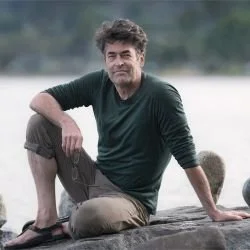
Chris Jordan creates photographic digital images of jarring statistics related to American consumption. Each large-scale image gives visual life to incomprehensible statistics like 320,000 light bulbs, equal to the number of kilowatt hours of electricity wasted in the United States every minute from inefficient residential electricity usage, and 28,000 42-gallon barrels, the amount of oil consumed in the United States every two minutes. Jordan graduated from the University of Texas School of Law and, while interested in art, made his living as a corporate attorney in Seattle.
Episode Description
A 2010 statistic reports that, on average, there are 29,000 personal bankruptcy filings per week in the US, while another states that, on average, 50,000 pieces of floating plastic per square mile are observed in the Pacific Ocean. How might art be used to convey the magnitude of these statistics, suppose 29,000 credit card images of them were arranged to compose a larger image of a full moon, or 50,000 plastic bag images were used as elements to produce an image of a whale? Would you find yourself drawn to the art, and then deeper into the story that inspired the art? Our episode today considers how art might be used to convey and engage people in considering human impact on the world, or the human experience in it, with guest Chris Jordan.
Full Transcript
John Bailer
A 2010 statistic reports that there are, on average, 29,000 personal bankruptcy filings every week in the U.S., while another statistic from this year reports that, on average, 50,000 pieces of floating plastic per square mile are observed in the Pacific Ocean. How might art be used to convey the magnitude of these statistics?
Suppose 29,000 credit card images were arranged to compose a larger image of a full moon, or 50,000 plastic bag images were used as elements to produce an image of a whale. Would you find yourself drawn to the art, and then deeper into the story that inspired the art?
Our episode today considers how art might be used to convey and engage people to consider human impact on the world, or human experience in the world. I'm John Bailer. Stats and Stories is a production of the American Statistical Association, as well as Miami University’s Departments of Statistics and Media, Journalism, and Film.
I'm joined in the studio by my colleague, Rosemary Pennington, Chair of the Department of Media, Journalism, and Film. Our guest today is Chris Jordan, photographer and artist. His fine art photography series, Running the Numbers, depicts statistics about mass consumption and mass culture.
Chris, during a recent trip to the Monterey Aquarium, I saw a piece of your art, Shark Teeth. A nearby poster says that Chris Jordan challenges our “use-and-discard” society. At least in this series, you did. At first glance, this was an image of two sharks swimming, but on closer view, the image is constructed from individual images of fossilized shark teeth — 270,000 of them.
The question of why 270,000 is that it is estimated that 270,000 sharks of all species are killed globally every day for their fins. How did you first get inspired to create this art that represents mass consumption and mass culture?
Chris Jordan
I remember so clearly the moment where this project began, and at the time I had no idea it was going to turn into a multi-year thing. It was just one idea that suddenly hit me in a really strange way, and that was it.
It was not too long after 9/11, and I read a headline in The New York Times that said, “Jeep recalls 800,000 Liberties.” It hit me as a really weird pun because that was right when Homeland Security, like the Bush administration, was doing all this militarization and surveillance. I thought, “Yeah, I recall having 200,000 liberties too, and they’re all being taken away one by one.”
Then I started reading the article, and Jeep had just recalled 800,000 of its Liberty model cars for a problem with the differential gear. I thought, “800,000 of just one model of car? That must go back to 1963.” Then I read in the next paragraph that they had just released the Jeep Liberty four years previously.
So: 200,000 Jeep Liberties per year. Like, how many is that? I tried to visualize in my mind how long a line of Jeep Liberties would be, and I realized I didn’t know if that was five miles, 50 miles, or 500 miles. I could not fathom in my mind 200,000 Jeep Liberties per year.
So I went to Jeep’s website, took a tiny little JPEG of a Jeep Liberty, and started duplicating it in Photoshop. I made 200,000 of them, and by really strange luck, it came out as this long, tall rectangle that looked like one of the Twin Towers.
I was like, “Whoa, that’s weird. I’m going to print it out and see what it looks like.” It came out 11 feet long from my printer, and I remember the shock of seeing that number represented visually and realizing I had no comprehension of that number until I saw it represented with my eyes.
That was the first image in this whole series that then led me down a track that lasted almost a decade.
Rosemary Pennington
How did you decide what statistics you were going to focus on in your work?
Chris Jordan
It was always reading a statistic that just broke my heart. It wasn’t only things about mass consumption. It was injustices happening, like the number of dogs and cats that are euthanized in the U.S., or the number of women getting surgical treatments to their bodies because they don’t feel beautiful enough.
Those things are tragedies that are happening, and they’re so hard to connect with because the numbers associated with them are so huge that we can’t comprehend them.
John Bailer
When I think about these images, they’re sort of like what Rosemary asked in that question about what statistics engaged you. But then there are two other decisions you were making: one, what are the elements you will use to represent that statistic, and ultimately, what kind of larger image would you produce?
Can you talk a little about those two components?
Chris Jordan
Yeah. This is a process that emerged over quite some time, but one thing I knew right from the beginning was that I wanted to represent the complexity of these issues and honor them with as many layers of meaning as I could figure out how to build in.
In that way, making these pieces always felt like solving a Rubik’s Cube. What are the small images going to be? What’s the big image going to be? Each one of them could be anything.
So I would think: what is an iconic way to represent whatever this statistic is, but in a way that shows my own complicity and the emotional complexity of the issue?
For Shark Teeth, for example, I read this heartbreaking statistic that there are an estimated 100 million sharks killed per year for their fins. That is taking shark populations to extinction everywhere in the world.
The biggest tragedy is that it doesn’t need to happen at all, because sharks are being killed for their fins because countries in Asia believe shark fin soup is an aphrodisiac. What’s actually happening is that mercury is concentrated in shark fins more strongly than in any other seafood in the world. It goes into their cartilage, which is their fins, so people who drink shark fin soup are poisoning themselves with really high levels of mercury.
I wanted to build some of that into the piece, and also the idea that they’re going extinct — that’s why I used fossilized shark teeth. The two sharks in the image are swimming in a yin-yang relationship to each other, just to remind us of the deep wisdom of that culture that is being forgotten.
The number is the statistic that takes it down to the number of sharks killed per day.
There’s also a really cool story about how I got all those shark teeth. I thought, “Okay, I want to use fossilized shark teeth. Where can I get a bunch of fossilized shark teeth?” So I went online and found a guy in North Carolina who collected them and sold them online.
I wrote to him and said, “Dude, is there any chance you might be willing to send me your entire collection? It’s worth tens of thousands of dollars. Just let me photograph them, and then I’ll send them right back.”
And he said yes.
It was only a bag of — I can’t remember — maybe 1,000, but what I did with a lot of the Running the Numbers pieces was make a “pancake” of them, photograph it, stir the pancake around, photograph it again, so it looked like 1,000 different shark teeth. I did that for two days until I had lots of different images of the same shark teeth over and over that I could layer on top of each other.
Then I separated out the ones with more blue color so I could make the Chinese characters for mercury, which is what those characters are in the middle.
By a really interesting coincidence, the Chinese word for mercury is “silver water,” which also feels like what sharks are.
So it all kind of came together. To me, that’s the most layers of meaning I could build in there, and that’s the piece Shark Teeth.
Rosemary Pennington
I’m looking on your website, and there are two pieces that are intriguing to me. First, there’s one that seems to reference The Birth of Venus with garbage bags. Then there’s another — I love Van Gogh; he’s one of my favorite artists — and you also have this piece referencing Skeleton Smoking a Cigarette. They’re such different riffs off those artworks.
Can you talk through your process of how you produced those? Truly, they are so uniquely different.
Chris Jordan
Well, first of all, one of the principles I use in choosing the big image is that the experience of the full-size prints is exactly the opposite of what happens when you look at the images on the website.
Imagine walking into a museum and seeing this huge artwork. You first see it from a distance, and I want to avoid bringing up the viewers’ defenses. So it’s intentionally not something alarming or dark. It’s just, “Oh, cool, a giant orange rectangle,” or, “Oh, that famous painting of The Birth of Venus that we all know.”
Then, as you walk closer, it gets fully in your face. I optimize the size of the small objects so that you have to get almost nose-to-print close to see what they are. Then there’s this little moment of shock: “Oh my God, look, it’s all plastic bags.”
There’s almost a humor in it, and it’s really fun to watch people react. “Oh honey, you’ve got to come see this one.” Even kids love seeing what the thing is up close.
Then you comprehend the number. The quantity becomes totally in your face, and only then do you finally read that this represents the number of plastic bags we use in the world every 10 seconds, or whatever the statistic is.
For Venus, I think I had about 70 plastic bags, and I photographed them individually — each bag maybe 10 times in different rolled-up configurations.
I really love The Birth of Venus. Not only is it one of the most beautiful paintings ever made, but there’s also this profound meaning in it. Venus is the goddess of love, but not sexual or erotic love — that’s Aphrodite, who’s also in the painting, up in the corner hanging out with her boyfriend, Zephyr.
Venus is the goddess of earthly love, our love for our mother, Mother Earth. The story is that Venus was born from the sea as a fully grown woman and floated to shore in a clam shell. So the mother of Venus — the mother of the goddess of earthly love — is the ocean.
That made it the perfect piece to illustrate the ridiculousness of our behavior in polluting our oceans with plastic.
The only change I made to Botticelli’s painting was adding a tear in Venus’s eye. I photographed a plastic bag filled with water, cut it out from its background, and pasted it in as a tear of sadness.
That was kind of the process. It’s thousands of small individual photographs all joined together. One thing I love about this process is that even though the prints are super huge — like eight feet wide — when you walk up close, they’re incredibly detailed because they’re not one giant photograph. They’re hundreds of thousands of small photographs, all very high resolution.
John Bailer
The theme of plastic — or the impact of plastics — is a pretty common one in your work. I also love the image about the 2.5 million pieces of plastic collected from the Pacific Ocean that, as you step back from it, becomes this famous image of The Great Wave. I thought that was such a lovely connection.
Did that seem like a really natural connection to you? Can you talk about that process and that image?
Chris Jordan
That’s the one I’m most technically proud of. It took me months to create, and the image file was so huge — I think it was around 130 gigabytes — which was way bigger than Photoshop was designed to handle.
It would crash while saving and corrupt the file. Multiple times I had to start completely from scratch after weeks of work. But it finally worked.
That one was built entirely manually, piece by piece, in Photoshop. I had no help from automation software.
The idea behind it was that the stewards of the Pacific are the West Coast of the U.S. and Asia, so I thought it would be interesting to build a cultural bridge across the Pacific by appropriating a piece of Japanese art to have this conversation about plastic in our ocean.
Hokusai’s Great Wave is, for me personally, one of the top three most powerful pieces of spiritual art ever made. It’s a very clever yin-yang symbol: the wave and the negative space of the wave create that relationship.
My understanding of the piece is that Hokusai was addressing two fundamental yin-yang relationships. One is the relationship between stillness and movement — the most fundamental relationship in the universe. You have the stillness of Mount Fuji in the middle and the movement of the wave.
Then there are these canoe men who are about to get crushed by the wave, but they’re still somehow held safely. It represents the chaotic terror of the human journey and our vulnerability to the elements, while also showing that we are held safely by the entire universe.
It’s this fantastic work of art all contained in one image.
The other yin-yang relationship is our tremendous fragility contrasted with the wild movement of the elements.
John Bailer
You’re listening to Stats and Stories, and we’re talking with Chris Jordan about capturing and conveying statistics about mass consumption and culture through art.
We’ve had episodes on this podcast discussing the problem with plastics. Your work on the Midway Project produced images that translated an abstract discussion of plastic pollution into a dramatic and immediate depiction of impact.
Can you talk a little bit about the inspiration for this work?
Chris Jordan
The inspiration for my Midway Project came from a desire to face the issue of ocean plastic pollution in a more personal way.
The work we were just talking about — my huge photograph of The Great Wave made out of 2.4 million pieces of plastic — and that entire Running the Numbers series always left me with a little dissatisfaction because it was abstract. It was conceptual art.
Up until I started doing that work, I never liked conceptual art, and honestly, I still don’t. It’s too much in its own head. To me, the great power of art is to get us into our bodies, to remind us that we feel something.
All through the process of studying plastic in the ocean and creating those works, I had this craving: how could you face this issue in a more personal way?
I got invited to a meeting held by an amazing activist named Manuel Maqueda. On his own dime, he brought together about 10 people in the world who knew anything about ocean plastic at that time. I think this was around 2008.
We met at the Google campus, and one of the people there was Anna Cummins, who later became one of the world’s leading scientists on ocean plastic pollution.
We were talking about the Pacific Garbage Patch, and Captain Moore — another leading advocate on the issue — said, “You can’t photograph the Pacific Garbage Patch. It’s too spread out. It’s like soup. It’s millions and millions of tiny pieces spread out over hundreds of thousands of square miles of ocean.”
I remember slapping my knee in frustration and saying, “Damn, I’m a photographer. I want to take a photograph of the Pacific Garbage Patch.”
Anna Cummins, sitting right next to me, turned and said, “You want to photograph the Pacific Garbage Patch? Go to Midway Island and look inside the stomachs of dead baby albatrosses.”
Rosemary Pennington
As we’re talking, I’m looking through those photos again, and they are incredibly powerful. I guess I’m wondering — when you were told that, and then when you actually went there — how do you get yourself into a space where you can take those photos?
Because you have some really lovely photos of young birds, and there’s a photo of what I’m assuming is a parent and baby bird. Then, in the same series, you have these images of the corpses of birds filled with plastic.
How do you get yourself ready to take that kind of photograph?
Chris Jordan
The process that unfolded for me on Midway took years. It began with a trip to the island that I thought was going to be the whole project.
On that first trip, there were no live albatrosses on the island. It was a time of year when all the birds were out at sea. It was September.
So my first experience of Midway was like being in a killing field. It was this empty, silent, horrible-smelling place — this otherwise magical tropical island covered with the bodies of tens of thousands of dead birds filled with plastic.
The experience was devastating for me.
I brought a small team with me, not to make a film yet, but just to record the process of photographing the birds because I knew people would think I had faked the photographs. There was so much plastic in the birds.
I remember when Anna first showed me a photograph someone else had taken on the island. My immediate thought was, “They put that plastic in there.” It would be so easy when no one’s looking to add a little extra plastic to increase the emotional impact.
So I knew there would be doubt about the credibility of it, and for forensic purposes, I brought a small documentary crew to film the whole process.
We all came back from that trip devastated. I fell into a state of depression.
I published the work, and it went viral — far more than anything else I had ever done. This was before social media. I made a slideshow of the birds filled with plastic and emailed it to friends, who then shared it.
Tens of thousands of emails started pouring in — not from people who felt inspired, but from people having what felt like trauma responses. They told me they felt panicked and hopeless.
That broke my heart because that’s not the effect I want my work to have.
I went to two of my teachers and elders and asked if they could help me write an artist statement that would somehow make the work feel hopeful.
Both of them said the same thing. They said, “No. These are the hardest photographs we’ve ever seen. You have to go back to that island. You’ve only seen a sliver of the story.”
It was incredibly expensive and physically difficult to get there, but I knew they were right.
When I went back, that’s when I met the live birds and began to see the other side of the story — the incredible beauty of these beings who have no fear of humans.
We went back again and again during the hatching season. You could literally be right in the nest with the camera, and the parents were completely okay with it.
The images from there are beautiful.
Rosemary Pennington
Yeah, they really are.
John Bailer
Implicit in seeing images like this is a call for change — a change in behavior or action.
What are some of the hopes you have when you produce a collection like this?
Chris Jordan
I love that question because it really gets to the heart of my intention with all my work.
I don’t want to make a call for change. To me, that’s a fundamentally broken part of the environmental conversation — everybody telling everybody else how they should behave.
I trust that if people can reconnect with themselves, if we can remember together that we love our world, then I don’t have to tell anybody what to do after that.
It’s not my place to tell people how they should behave once they remember this fundamental thing.
Maybe one person becomes a passionate musician and puts love out into the world that way. I’ve always thought Stevie Wonder is one of the best environmental activists of all time — not because he says anything about the environment, but because his energy is so inspiring.
So I trust that if I can help people take one step toward remembering love and beauty, then everything else is up to them, and they’ll do the right thing.
Rosemary Pennington
I was going to ask you about your Beauty Emerging collection. I’m looking at this image from the Strait of Magellan from 2023. It looks like a sunrise or sunset — I don’t know which — but it’s beautiful.
I know you’re moving toward this reflection of beauty. Why do you feel pulled in that direction?
Chris Jordan
Something happened to me during the pandemic that really changed the way I see everything.
Actually, my connection with beauty began earlier than that. It really started during the Midway project. That’s the emotional arc I took viewers through in the film — starting with horror and ending with beauty and love.
During the pandemic, I finally ran out of excuses not to meditate, and I finally did.
Rosemary Pennington
Oh man, do I feel that.
Chris Jordan
I was completely alone for about a year and a half, and during that process I had some insights.
On a purely energetic level, I realized I had been contributing to the amplification of darkness in the environmental message.
I sat with that for a long time, wondering: how do I withdraw the darkness while still staying focused on the problems? Because we can’t just ignore bad news and become completely “namaste” about everything. That’s a mistake the New Age movement sometimes makes.
I had this experience of zooming back from the darkness and seeing it as a form in front of me.
All the bad news in the world — environmental destruction, injustice, suffering — is finite. It’s all caused by us.
If you hold all of that in your mind, all the injustice that has ever existed and ever will exist, you can step back far enough to see that it’s all contained within something infinitely larger: beauty.
Beauty extends all the way to the edges of the universe.
I don’t want to turn away from darkness. We have to stay focused on it. But how do we focus on it without collapsing into paralysis, depression, and overwhelm?
For me, the answer is perspective.
Instead of living inside the darkness, we zoom back just a little further and remember the beauty surrounding us in every moment and at every scale.
That’s my new mission: to amplify beauty — not as denial, but as a more whole worldview.
John Bailer
Well, Chris that’s all the time we have. Stats and Stories is a partnership between the American Statistical Association and Miami University’s Departments of Statistics and Media, Journalism and Film.
You can listen to us on Spotify, Apple Podcasts, or wherever you get your podcasts.
If you’d like to share your thoughts on our program, send your email to statsstories@amstat.org or visit statsandstories.net.
Be sure to listen for future editions of Stats and Stories, where we discuss the statistics behind the stories and the stories behind the statistics.