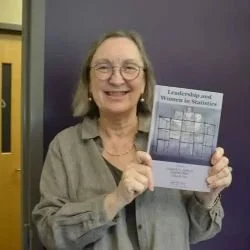
Amanda Golbeck is the Associate Dean for Academic Affairs in the College of Public Health at the University of Arkansas for Medical Sciences, where she's also a professor of biostatistics. Golbeck's known for her work on health numeracy, demography, and human intervention trials, but she's also known for her work on statistical narrative and for the biographies she's written. In 2025, Golbeck published Florence Nightingale David: A Passionate Probabilist, Statistician, Historian, and Leader, and in 2017, Equivalence: Elizabeth L. Scott at Berkeley. In 2016, Galbeck received the Elizabeth L. Scott Award from the Committee of Presidents of Statistical Societies for her outstanding efforts in enhancing the status of women and minorities, fostering new leadership opportunities for women and men, promoting diversity at all levels, and advocating for a more inclusive, open, and supportive atmosphere in the statistical sciences.
Episode Description
Women regularly hold leadership roles in stats departments at universities and in major statistical organizations, but it wasn't so long ago that women had to fight to be included. At one point, women faculty had to climb through the windows of the faculty club at Berkeley to attend meetings there; the stories of the struggles of women to be accepted in the profession aren't always visible. But one scholar is working to ensure those stories aren't forgotten. That's the focus of this episode of Stats and Stories with guest Amanda Golbeck.
Rosemary Pennington
Women regularly hold leadership roles in statistics departments at universities and in major statistical organizations, but it wasn't so long ago that women had to fight to be included. At one point, women faculty had to climb through the windows of the faculty club at Berkeley to attend meetings there. The stories of the struggles of women to be accepted in the profession aren't always visible, but one scholar is working to ensure those stories aren't forgotten. That's the focus of this episode of Stats and Stories with guest Amanda Golbeck.
Golbeck is the Associate Dean for Academic Affairs in the College of Public Health at the University of Arkansas for Medical Sciences, where she's also a professor of biostatistics. Golbeck's known for her work on health numeracy, demography, and human intervention trials, but she's also known for her work on statistical narrative and for the biographies she's written. In 2025, Golbeck published Florence Nightingale David: A Passionate Probabilist, Statistician, Historian, and Leader, and in 2017, Equivalence: Elizabeth L. Scott at Berkeley. In 2016, Golbeck received the Elizabeth L. Scott Award from the Committee of Presidents of Statistical Societies for her outstanding efforts in enhancing the status of women and minorities, fostering new leadership opportunities for women and men, promoting diversity at all levels, and advocating for a more inclusive, open, and supportive atmosphere in the statistical sciences.
Amanda Golbeck
It's my pleasure. Thank you for having me.
Rosemary Pennington
In 2021, you published an article in Significance about these two women, F. N. David and Elizabeth L. Scott. Can you just explain a little bit, kind of broadly, what drew your attention to their stories?
Amanda Golbeck
Well, I was a graduate student at the University of California at Berkeley, and I actually had the wonderful pleasure of meeting both of these people and knowing them. Elizabeth Scott was my advisor for my master's thesis, and F. N. David helped me to get a consulting contract with the Forest Service.
John Bailer
Well, that's such great good fortune, to have this connection to, to meet up with these two kind of stellar people in the field. You know, you've written these two books. I mean, what is your process to kind of explore and get the background and the story down for writing a biography like these?
Amanda Golbeck
I think it was different from one book to the other. For the Elizabeth Scott book, I knew that there was a fabulous archival library at Berkeley called the Bancroft Library, and I knew that because I started out as a Ph.D. student in anthropology there, not biostatistics. And I took a course called History of Anthropology, and I was, like, the only person in the class. And so, I mean, that was a real benefit because when it came time to do my paper, I had an idea of what I wanted to do, and the person was somebody who, a man actually, who I thought deserved more recognition for his work. And it turned out he had spent some time at Berkeley, and so we figured out that there were some articles about him or some papers about him in the Bancroft Library.
So my professor of anthropology walked me across campus, took me into the archive, and basically showed me what to do. So when it came time for me to think about doing a book, and the one on Elizabeth Scott, I thought, well, there surely will be some materials on her in Bancroft Library because she had spent her entire career at Berkeley.
So I looked online. Actually, there was an online index, and in the index it showed that there was a lot of material for Elizabeth Scott. There were, like, 148 legal-sized boxes of material because what had happened is she died in office, if you will. She died while she was still working, and so Bancroft Library knew that she was important, and so they just took all of her stuff and boxed it up and put it in the archive.
But the problem for me is that those materials were marked "unprocessed, unavailable for use." So, you know, I guess I could have just stopped there, but I didn't. I thought, well, okay, the boxes exist. You know, maybe I could go through everything.
So I contacted the head of the university library, told him what I wanted to do. I told him I was an alum. I told him I was going to write a book, and then he referred me to the head of the Bancroft Library, and basically they said yes. So they allowed me to do this because I was an alum and because I was willing to look through all 148 legal-sized boxes.
So that was an interesting experience, you know. I mean, some of it made me happy. Some of it made me sad because, you know, there's a lot of—they had a lot of setbacks in what they were doing. But I was particularly interested in Elizabeth Scott's work on academic women because when I was a graduate student there, I heard a lot of stories about her telling stories about how the women were not allowed to use the world's biggest telescopes.
Excuse me. So, so that was kind of what happened with the Elizabeth Scott project. And the book is pretty thick. In my mind, it's really like two books. There's, like, a biography part, and then there's a microhistory of the academic women's movement. So, if you're interested in how women organized and fought for other academic women, that's the place to look.
Okay, so that was Elizabeth Scott.
F. N. David was different because she had spent a lot of time at Berkeley because she was a close associate of Jerzy Neyman's in the Berkeley department, and she had spent the last part of her career at UC Riverside as their founding chair of statistics. But she also had this relationship—she worked as a consultant for many years with the U.S. Forest Service, which was located just outside of Berkeley.
And so with her, I thought, well, let me see what's in Bancroft Library because she had spent years there and she had taught history of statistics or history of probability at Berkeley, and so I thought maybe there'd be something.
Amanda Golbeck
Well, there were, like, five boxes, which isn't [much], and I had looked through them at some point previously, just out of curiosity, before I decided to write the book about her. And they were—I knew there wasn't enough in there to write a book, but somehow or other I thought, I'm going to do this anyway, or I'm going to try to do it anyway.
So I had to look farther afield, and so I looked. The first obvious place to look was University College London, where she spent most of her career. Well, guess what? Women don't—there, there just aren't a lot of archival materials about women there, and they tend to be buried in men's collections.
So the materials that I found about F. N. David were not in an F. N. David collection, like Elizabeth Scott's were in Elizabeth Scott's collection. What I found is that they were buried in Egon Pearson's files and Karl Pearson's files and J. B. S. Haldane.
And then even that wasn't very much, you know. So I had to look further, and I quickly figured out that she had done all this war work for the World War II effort on bombing strategies, and she had written multiple white papers for the government, and it turns out they had just declassified them, so I was able to get those. That was exciting for me as a biographer.
And then, let's see what else. I found out where she went to grammar school, and there was a person working there who was really interested in the project, and she came up with a bunch of materials from F. N. David's school days.
I'm trying to—I did some site visits. Like, I went to the little village where she was born, and so there's some information about that. I went to visit her gravesite, which is in the UK. She was so British that even though she emigrated to the United States to be chair at Riverside, she had her body—she arranged to have her body sent back to the little town that she had a cottage in in the UK.
So I know I'm missing some things, but that gives you a flavor of it. It was a lot harder to find stuff about F. N. David than it was to find stuff about Elizabeth Scott.
Rosemary Pennington
So we'll just start with F. N. David, since we're there. What made her a figure that you wanted to write about?
Amanda Golbeck
She had a really big presence at Berkeley, even though she wasn't on the regular faculty. When people would talk about her, it was more like they would say her name with great emphasis, like, "F. N. David," you know, instead of just F. N. David. So she had an emphasis about her, and she was definitely, you know—well, her name was well known, but what made her who she was was not well known.
So I can remember one of the projects that I worked on was to get—COPSS had two awards, one in the names of women. One was in the name of Elizabeth Scott, and the other one was in the name of F. N. David.
And I remember, so I had spent a lot of years in academic administration, and I remember going to a JSM, coming back to the faculty for a while when I started to write the first book, the one on Elizabeth Scott. I remember going to the JSM and looking, and there would be these signs, you know, telling you who the prominent speakers were, and they were all men, and it really surprised me. I don't know why, but it just surprised me.
So I thought that there should be some lectures named after women, but there weren't. I mean, 178 years of the JSM had happened, and there were no lectures named after women.
So there's kind of a longer story here. But what the part that I wanted to tell, especially, is that I remember sitting across in one of these big rooms at the JSM, maybe listening to the latest award being given there, the latest F. N. David Award or something. And I remember texting or emailing with a colleague across, way across the room, and she was saying, "Well, what did she do that was so important?"
And I remember writing back, "Well, she wrote nine books," you know, which for the time, being a woman, was phenomenal. And so I realized that people didn't know much about her, even though she had this big award named after her. And the same turned out to be true with Elizabeth Scott.
So I think one of the things that I hope I have contributed is that people actually know something about these people who are being recognized by our major associations. Their stories are valuable in countless ways, and so I'm glad we were able to get the COPSS awards elevated to include the named lectureships.
Rosemary Pennington
You're listening to Stats and Stories, and we're talking with Amanda Golbeck about F. N. David and Elizabeth L. Scott and their contributions to the field of statistics.
John Bailer
So, could you sketch out a little bit about Elizabeth Scott's contributions?
Amanda Golbeck
Yeah, she contributed in, like, I would say about five major areas. Her Ph.D. was actually in astronomy, and she published in astronomy journals throughout her career. Then she went to work for Neyman in his statistical lab during the war, and basically turned herself into a statistician. So she has some papers in peer methods.
She also did some work in atmospheric science because cloud seeding was happening and it was expensive, but nobody really knew whether it worked or not. You know, the cloud seeders claimed that it did, but the question was, did it really work?
And so Neyman and Scott took that up for many years. They worked on cloud seeding, and they figured out that, you know, it doesn't always increase rainfall. It doesn't always decrease hail. It can do the opposite, and nobody really understands the conditions for this.
She worked on studies in ozone depletion and health. So she did some biostatistics work, basically toward the end of her career.
And then when she was about 50 or so, that's when she started working on women's issues, and that was kind of something she just fell into. When I went over to Berkeley and I interviewed people that she worked with on those projects, they couldn't really remember how they all got started with it. But I was able to figure that out through the records.
And basically, there was a lot of unrest in the cities and lots of things being, you know, burned up, and I mean, it was sort of a disaster time. And so the president of the university decided that he thought that the university should get involved in trying to solve these problems.
And so what happened was he basically challenged his faculty to, you know, start doing research in this area and to try to find some solutions.
Well, one of the people in the systems office, a woman, she thought, well, maybe women leaders should look at this too, and maybe they have something special to contribute. So she collected a bunch of women leaders on campus. There weren't that many at the time, but the ones that were there brought them together and basically kind of introduced this whole project.
But what the women got interested in was women's issues because they realized that it wasn't just minorities who were near absent on the campuses; it was also women.
And so Elizabeth Scott's story is interesting because she was such a researcher at heart that she right away contributed the research questions, like, why are there so few women on the faculty, and why are there so few women pursuing graduate studies and earning their Ph.D.s?
And then that soon turned into, why are women being paid less when they have the same experience and education? So always a researcher.
John Bailer
So that was part of, you know, in your title of this, the Significance piece, it was "The Road Less Traveled." So that was part of the pivot that you saw in terms of the work and focus that she had in her career. Could you talk about that also with F. N. David?
Amanda Golbeck
If you don't mind, before I go to F. N. David about that, because Elizabeth Scott's "Road Less Traveled," I think there's also an emphasis to be made there that she did a lot of—most of her work before the women's work with Jerzy Neyman. They were, like, really close collaborators on pretty much everything.
John Bailer
Oh, I'm sorry to interrupt. We had a little dropout on her audio stream. If she could pick it up about 20 seconds after my question. Yeah, right after. Yeah, we had just a little dropout. Okay, could you start again with it?
Amanda Golbeck
Yeah, I wanted to emphasize what Elizabeth Scott's "Road Less Traveled" really was. And, reflecting on this, she had done much of her work with Jerzy Neyman, and if you think about it, she was the astronomer, but when she published with Neyman in astronomy, he was first author. When they did the statistical methods papers, he was always first author, even though, you know, some of the work was on stuff that came out of her dissertation.
When they did this cloud-seeding atmospheric science studies, Neyman was always first author. And so what happened with her "Road Less Traveled" is that she went and worked on the women's studies, and he was not part of that.
So that's what made her stand out. She took that road less traveled, and when you think about it, you know, what she was doing with Neyman was—I mean, he was this big-name guy. Women were sort of thought to be, like, homemakers at the time and stuff. And so what she achieved with him was pretty remarkable.
But she didn't really have an equal representation in the literature. And so you could easily look back at that literature and say, well, Neyman was the primary contributor. But really, what the situation was is that Neyman insisted that everybody that he worked with—that the publications be in alphabetical order by last name, which is a mathematical tradition, but certainly not the one that a lot of us operate within.
So that was sort of the Elizabeth Scott "Road Less Traveled."
The F. N. David "Road Less Traveled" has a couple of elements to it. I think mainly it's her deciding to emigrate to the United States in order to lead, because what happened to her is she did everything that was expected of her at University College London, and she worked under Karl Pearson at first, and then Egon Pearson after that.
And Egon, if you read his performance evaluations of F. N. David, he was always highly complimentary. You know, not just of her work per se, but how she contributed to the growth and development of the department. So she was helping him with the leadership of the department and growing it.
But when it came time for Egon to retire, he made sure that F. N. David did not succeed him. He wrote to the provost and said, you know, she doesn't have the temperament for this job. And, you know, temperament is a pretty nebulous kind of category.
So, but that's what happened to her. And then I was able to find out, you know, way back when at her school—I told you that I figured out where she went to school and had a relationship with someone there who sent me materials. F. N. David was—headmaster, not headmaster—she was head girl at her school for four years in a row.
So she was, like, recognized as a leader early on. But it wasn't going to happen for her at University College London, even though J. B. S. Haldane, this big-name guy, wrote a letter in support saying, you know, you're not going to find a better person than F. N. David for this job.
So she ended up going to University of California, Riverside, and was chair there for 10 years, and was one of the few chairs of a research department in the United States who was a woman at that point.
John Bailer
So, so what was—sorry?
Rosemary Pennington
Go ahead.
John Bailer
All right. So, what were the biggest surprises for you as you did the research for these two biographies?
Amanda Golbeck
Oh, that's an interesting question. A lot of it was a surprise because, you know, I kind of had my head down when I was going to school, you know, and I just kind of did what I was supposed to do. And I didn't realize that I was coming up in a period where this change was taking place, you know.
So I think for me, relating it to me personally, that was a surprise—that I was actually living through the beginnings of the academic women's movement and surely benefiting from it.
F. N. David—nobody knew why, nobody knew how she became a statistician, and nobody seemed to know how she came to the United States. And I say that because I went back to Berkeley recently. At the—it must have been at the end of last year—they had the 70th anniversary of the department, and I met with somebody who wanted to talk to me about F. N. David because he knew her and he knew her work and so forth.
And he basically didn't know, you know, why she came. And so I think it was sort of a big secret, you know. And I remember when I was in the archive at University College London, and I came up with this piece of paper where Egon was writing to the provost. I remember going like, "Wow."
So that was a big surprise for me, you know. And so then I was able to explain, use the book to explain basically what happened to her, you know, and how she came here.
Rosemary Pennington
I want to circle back to something from the beginning about yourself, because I feel like people probably also have these questions. You said you started out in cultural—or in anthropology. What made you shift from anthropology into statistics?
Amanda Golbeck
Yeah, I was always interested in demography, and the person who was going to chair my dissertation was into demography, of course. And he had been solicited by the American Anthropological Association to do a market study of Ph.D.s in anthropology in academe.
And, you know, he had a great sense of ethics. I mean, I really, all these years, thought about this because he called the graduate students together in anthropology and said, "Well, here are the results, and you have to decide what you want to do. You can stay here a long time and kind of wait this out," because there basically—it showed, the study showed, that there weren't many jobs. "And you can wait this out, or, you know, you can kind of go do something else."
And I thought, well, you know, I'm doing demography, and I could go over to biostat. There was a guy, a faculty member, who was doing birth-and-death stochastic process modeling.
Okay, so I went over and I talked to him, and he said, "Yeah, well, how much math have you had?" And when I was an undergraduate, I had an anthro major, but I had every math course that I needed for a math major except for one.
Amanda Golbeck
Yeah, so he was, like, happy to see me, you know. And then he said, well, if we do this, if you get a Ph.D. in biostat, you should get a master's degree in statistics along the way because you'll be a better biostatistician, and you should go talk to Elizabeth Scott.
And so that's how I met Elizabeth Scott, and she was happy to have me too. So, yeah.
John Bailer
What a great, great trajectory. You know, one of the things I wanted to ask you about is, as part of your career beyond your biographies, you got involved with health numeracy. Could you just tell us a little bit about that? That was something I learned about you in doing some of the background for this. But I'm curious if you could tell a little bit of that tale.
Amanda Golbeck
Well, I had—I found out that the Institute of Medicine had put out a report on health literacy and the importance of health literacy. And when I read it, you know, I saw that numeracy was buried in there, you know. And I, being a statistician, I thought, that's not good, you know.
And so I put together a team of people, and, you know, we thought about it and wrote basically the first definition of health numeracy. And then I ended up teaching a course here in health numeracy for a number of years, which was really enlightening because, I mean, I always thought it was important, but I would get dual-degree students with pharmacy saying to me, you know, "This course was so important for me. I'm going to practice completely differently now," you know.
Because the first thing I do is point out to them how loaded their interactions are with patients, how loaded they are with numeracy, and people don't realize that, I think, when they walk into a doctor's office. You know, you have to think that through and pay attention.
But there's a lot of numeracy that happens, you know, in those encounters.
Rosemary Pennington
Stats and Stories is a partnership between Miami University's Department of Statistics and media journalism and film and the American Statistical Association. You can follow us on social media outlet formerly known as Twitter or Apple podcast, or other places where you find podcasts. If you'd like, share your thoughts on the program. Send your email to statsandstories@miami.oh.edu, or check us out at statsandstories.net, and be sure to listen for future editions of Stats and Stories, where we discuss the statistics behind the stories and the stories behind the statistics.