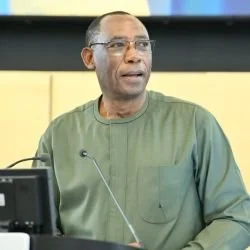
Oliver Chinganya is the chairperson of the Board of Directors of the Zambia statistical agency, and co-chair of the advisory board for Digital Earth Africa. He was recently appointed as a senior advisor at the International Growth Center at the London School of Economics. Formerly, he was chairperson of the Board of Directors of the Zambia Statistical Agency and co-chair of the advisory board of the Georgia Africa until January 2025. Chinganya served as director of the African Center for Statistics and chief statistician at the UN Economic Commission for Africa, also known as UNICA.
Episode Description
In order to promote the economic and social development of countries, you have to be clear about what economic and social development even means and how you'll measure these concepts. This is where official statistics excel. Many nations continue to build the capacity of their statistical systems to address the needs of their countries. Our episode today focuses on official statistics and statistical capacity development with guest Oliver Chinganya.
Full Transcript
John Bailer
In order to promote the economic and social development of countries, you have to be clear about what economic and social development even means and how you'll measure these concepts. This is where official statistics excels. Many countries continue to build the capacity of their statistical systems to address the needs of their countries. Our episode today focuses on official statistics and statistical capacity development.
I'm John Bailer. Stats and Stories is a production of the American Statistical Association, as well as Miami University's Departments of Statistics and Media, Journalism and Film. I'm joined in the studio by my colleague Rosemary Pennington, chair of the Department of Media, Journalism and Film.
Our guest today is Oliver Chinganya, Chairperson of the Board of Directors of the Zambia Statistical Agency and co-chair of the Advisory Board for Digital Earth Africa. He was recently appointed a senior advisor at the International Growth Centre at the London School of Economics. Formerly, he was Chairperson of the Board of Directors of the Zambia Statistical Agency and co-chair of the Advisory Board of Digital Earth Africa.
Until January 2025, Chinganya served as Director of the African Centre for Statistics and Chief Statistician at the UN Economic Commission for Africa, also known as UNECA. Until October 2025, he was Vice President of the International Statistical Institute. His career also includes senior roles at the African Development Bank, the International Monetary Fund, and the Zambia Statistical Office. He is a Fellow Chartered Statistician and Chartered Scientist of the Royal Statistical Society and is widely recognized for advancing statistical capacity and driving digital innovation across Africa.
Oliver, it is just a delight to welcome you to the podcast.
Rosemary Pennington
Thanks so much for being here.
Oliver Chinganya
Thank you very much.
John Bailer
Well, to start, how did you begin your career working in official statistics?
Oliver Chinganya
First of all, let me say thank you very much for having me this afternoon—or maybe this morning for you—and for allowing me to be part of this conversation.
How I joined the Central Statistical Office, which is now called the Zambia Statistical Agency, is actually quite interesting. I was a very young person at the time. I had just left secondary school, and we had what was called the National Service, where after finishing your O levels, you had to complete national service before attending college.
I went into National Service, which required six months of military training. During that period, the Central Statistical Office was looking for people to recruit. I happened to be one of five people interviewed, and I was selected.
I joined the Central Statistical Office in June 1979. At the time, I thought I was going to become an accountant. During the interview, they asked me what I wanted to do, and I said I wanted to be an accountant. Little did I know I would end up becoming a statistician.
When I moved to Lusaka and joined the office, I reminded them that I thought I would eventually go to India for accounting training. They told me that perhaps that would happen later, but for now they needed me to join the team preparing for the 1980 Census of Population and Housing.
At that time, we didn’t have GIS technology. Mapping had to be done manually, often by bicycle. So I joined as a mapper. I was sent to a training center where we learned how to map the country for census purposes.
The training lasted three months. Initially, I was supposed to work in Western Province, but because I didn’t speak the local language there, I was reassigned to the Copperbelt Province.
We used odometers and actual compasses for navigation. Because of magnetic variation, we had to make plus-or-minus three-degree corrections while mapping.
We worked right up until the 1980 census, and I participated in preparing and delineating the maps needed for the census.
Afterward, I again asked about accounting, but by then I had become increasingly interested in statistical work. Mapping involved a lot of calculations and trigonometry, and I found myself enjoying it.
I then learned about a training program within the Central Statistical Office organized by the United Nations Development Programme, or UNDP. The office operated its own training school.
I applied and was accepted into two programs: one lasting six months and another lasting twelve months. Together, they formed an 18-month program affiliated with the Royal Statistical Society.
That experience deepened my interest in statistics. Eventually, I attended the Eastern Africa Statistical Training Centre at the University of Dar es Salaam, and later studied in Southampton.
By 1991, I had become a fully qualified statistician.
I started very young—around 19 years old. I attended university while already employed. So I truly began from the grassroots, doing data collection and fieldwork before eventually becoming an analyst after completing my education.
Rosemary Pennington
Oliver, you could have gone in many different directions after studying statistics. Why did you decide to stay in official statistics?
Oliver Chinganya
I decided to remain in official statistics because, at the time, statistics was still a very new field in Zambia.
Back then, Zambia had only one university—the University of Zambia—and it did not yet offer statistics as a formal program. There were very few statisticians in the country, and there wasn’t even a demography program.
Many of the people helping build statistical systems were experts from India, Europe, the United States, and a few from Ghana.
It became clear to me that this was an important and emerging area where there was a great need for trained professionals.
At the same time, the idea of becoming an accountant became less appealing because I was already working within an institution dedicated entirely to statistics.
Official statistics became important to me because I saw how data could help policymakers make evidence-based decisions that improve the livelihoods of people in Zambia.
I could have gone into another profession, but I became increasingly drawn to statistics and the role it could play in national development.
John Bailer
You mentioned evidence-based information improving people’s lives. That sounds almost like a definition of official statistics.
Can you talk about why official statistics are important, especially in the context in which you’ve worked?
Oliver Chinganya
Official statistics are extremely important, particularly in developing countries.
No meaningful development can happen without reliable data and information. Development decisions cannot be made in a vacuum.
The information used for policymaking must be accurate, credible, and evidence-based.
For example, historical records show that when Zambia gained independence in 1964, the country had only about 100 university graduates. None were statisticians or engineers.
That illustrates how critical it is to have accurate information for planning and development.
Official statistics matter not only for governments but also for development partners and organizations that rely on data to make decisions affecting people’s lives.
If the information is wrong, then decisions will also be wrong.
For example, there was a country in East Africa that built a very impressive school based on the local population at the time. However, they failed to recognize that the population was nomadic. Eventually, the community moved away, leaving the school largely empty except for teachers.
Had they conducted proper feasibility studies and collected accurate data, they would have understood the population’s migration patterns before investing resources there.
That’s why good official statistics are so important.
Rosemary Pennington
I know you’ve also worked extensively on civil registration systems, especially through UNECA. Could you talk about that work and why it mattered?
Oliver Chinganya
Civil registration and vital statistics systems are critically important, especially birth registration.
Africa has historically had some of the lowest birth registration rates in the world. Many children are simply not officially registered when they are born.
Part of our work involved sensitizing communities—especially mothers—about the importance of birth registration.
When governments know how many children are being born, they can plan schools, healthcare, and social services more effectively.
Civil registration also includes marriages, divorces, deaths, and employment transitions.
We worked with organizations such as UNICEF and the Gates Foundation to promote birth registration awareness.
At one point, only about one in three children on the continent had officially registered births. Even today, many countries remain below 50 percent coverage.. That is still a major challenge.
John Bailer
You’ve witnessed enormous changes since 1980. What are some of the biggest improvements you’ve seen in official statistics during your career?
Oliver Chinganya
There have been many improvements.
In 1964, Zambia’s statistical office operations were actually based in what was then Southern Rhodesia, now Zimbabwe. Zambia itself had very limited statistical infrastructure.
Since then, we’ve conducted multiple national censuses and developed far more sophisticated systems.
Countries now create National Strategies for the Development of Statistics, which are essentially roadmaps for improving national statistical systems over three- to five-year periods.
We’ve also seen significant improvements in GDP measurement and national accounts. Countries have reduced benchmark-year gaps from 30 years down to 10 years or even five years.
Policymakers are also demanding far more data than they once did.
At the continental level, Africa now has the African Charter on Statistics, modeled after the UN Fundamental Principles of Official Statistics, as well as harmonized statistical frameworks such as SHaSA—the Strategy for the Harmonization of Statistics in Africa.
Universities across Africa now offer programs in statistics, demography, and data science.
These are major developments that reflect the growing importance of data.
John Bailer
What are some of the greatest remaining needs in statistical capacity development?
Oliver Chinganya
There are still many.
One major area is modernization. Many countries still need better technology and stronger statistical infrastructure.
Interoperability is also a challenge. Systems often cannot communicate with one another effectively.
In some places, staff still share a single computer or laptop.
Human capital is another issue. People need reskilling because the data ecosystem is changing rapidly, especially with artificial intelligence and new digital technologies.
We also need better dissemination and communication strategies. How should data be presented? How do we train policymakers, journalists, and the public to interpret data responsibly?
Misinformation is a growing challenge.
At the same time, international statistical standards continue evolving rapidly. For example, the world is already discussing the 2025 System of National Accounts while some countries are still struggling to fully implement standards introduced in 1993.
These are major challenges that still need attention.
John Bailer
Communication seems to be one of the central challenges.
How to you explain the value of official statistics to the public?
Oliver Chinganya
We’ve learned that large reports full of text are often ineffective.
So there’s been a shift toward visual communication and infographics.
For example, when discussing inflation or the Consumer Price Index, instead of presenting only numbers, you show pictures of sugar, cooking oil, transportation, and other goods people recognize from everyday life.
Visual communication makes statistics much easier to understand.
Even policymakers often prefer summaries and visual briefs over long technical reports.
Of course, researchers still need detailed analyses, but for the general public, simpler communication works far better.
People often say, “We don’t eat GDP.” So the challenge is explaining concepts like GDP per capita in ways that relate to everyday experience.
That requires simplification and visualization.
Rosemary Pennington
After COVID-19, there seems to be greater mistrust of data and statistics. How did the pandemic affect official statistics?
Oliver Chinganya
COVID created major difficulties.
Traditionally, price data collection required fieldworkers to physically visit markets. During lockdowns, that became impossible.
However, COVID also accelerated innovation.
Countries began experimenting with scanner data from supermarkets, mobile data collection, and other digital approaches.
The pandemic forced statistical systems to rethink how they operated.
One challenge was the gap in data collection during the COVID years. We had pre-COVID data and post-COVID data, but bridging that gap was difficult.
Still, I believe COVID ultimately created opportunities for modernization.
John Bailer
There’s also been growing distrust in government data generally. How do you deal with that challenge?
Oliver Chinganya
That has been very difficult.
One reason is that many people outside official statistical systems now produce data using private-sector tools and technologies.
They can produce information very quickly—sometimes within hours—while official statisticians may require months to conduct proper surveys and validation.
By the time official data is ready, decisions may already have been made.
So rather than insisting that only official statisticians can produce data, we need greater collaboration with the private sector.
We should create data labs and data science campuses that combine traditional methods with newer technologies.
Personally, I’ve begun to think that perhaps we should move from talking about “official statistics” to “public statistics.”
That would mean embracing collaboration while still maintaining standards and verification processes.
If non-official data can be verified and meets accepted standards, then perhaps it should also be recognized.
This may require revisiting the UN Fundamental Principles of Official Statistics to make them more inclusive.
John Bailer
That’s a fascinating idea. We may need to retitle the entire episode now
Unfortunately, that’s all the time we have for this episode of *Stats and Stories*. Oliver, thank you so much for joining us today.
Oliver Chinganya
Thank you. It has truly been my pleasure. There is so much more we could discuss, but I appreciate the opportunity. Thank you very much.
John Bailer
*Stats and Stories* is a partnership between the American Statistical Association and Miami University’s Departments of Statistics and Media, Journalism and Film.
You can listen to us on Spotify, Apple Podcasts, or wherever you get your podcasts.
If you’d like to share your thoughts on our program, send your email to statsstories@amstat.org or visit statsandstories.net.
Be sure to listen for future editions of *Stats and Stories*, where we discuss the statistics behind the stories and the stories behind the statistics.